NextPatient has a new look
No portal. No app. No login. Patients book, confirm, reschedule, or cancel online, by phone, or by text — inside Nextech, ModMed, athenahealth, AdvancedMD, NextGen, and DrChrono.
8,000+
providers trust NextPatient
The four gaps
If you’ve tried other scheduling tools and quietly switched back to phone bookings, these four gaps are likely why. None of them are about technology not being ready. They’re about the platform being built for a different kind of practice.
Most platforms force patients into portals. Patients won’t create an account to book a visit, and the ones who never log in are the ones you need to reach.
Specialty providers need provider-specific rules, appointment type triage, deposit logic and visit length variations, not a generic template.
Instead of removing work, the booking flow creates it. The front desk ends up cleaning up everything it got wrong.
The vendor doesn’t know your EHR well enough to keep data clean. The integration turns out to be a flat-file sync that runs overnight.
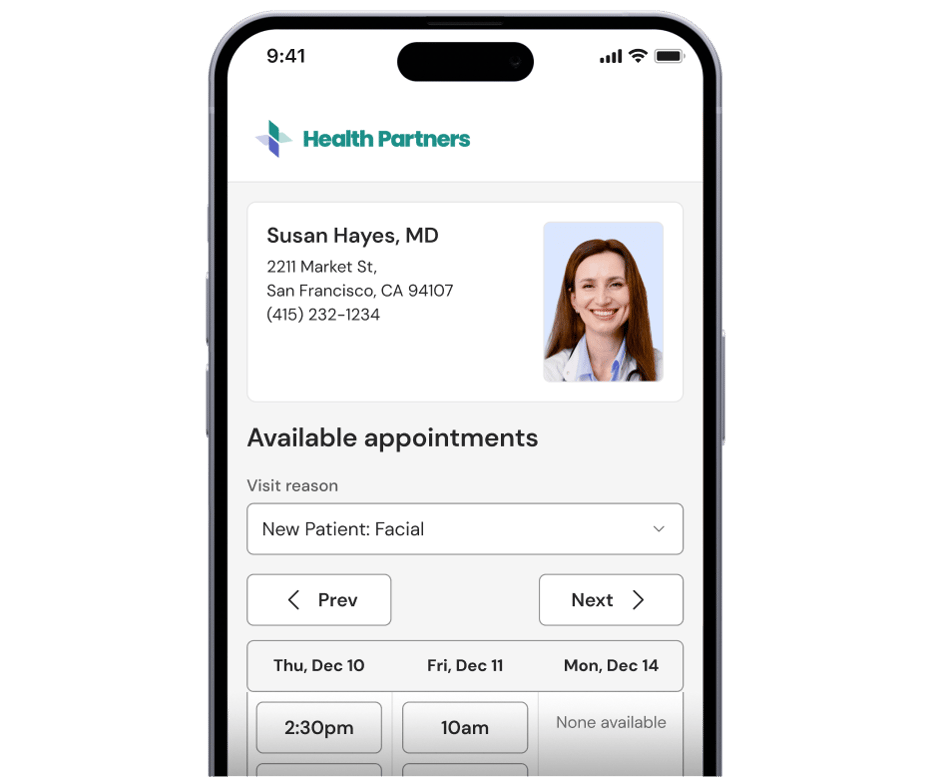
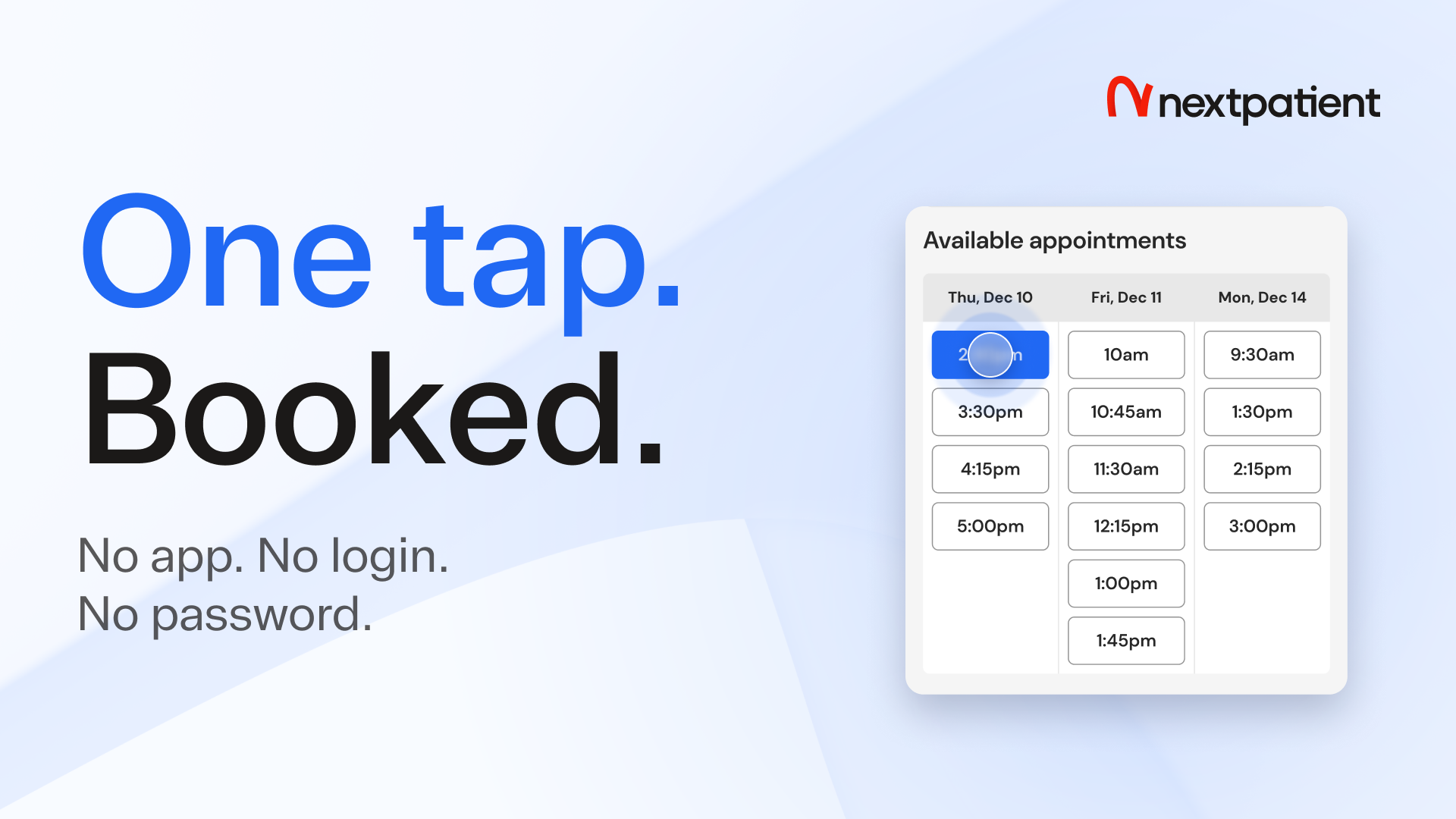
Online self-scheduling without a portal starts wherever patients already are: the "Book Online" button on your website or Google Business listing, or a link sent by text or email. The patient opens the link in their mobile browser, picks a provider, location, and time, enters their information, and confirms — without ever downloading an app, creating an account, or remembering a password. NextPatient is built around this flow.
The patient experience is the same whether they’re scheduling from your website, your Google Business listing, or a reminder notification:
Patient Self-Scheduling
Website, Google listing, or a text or email link
AI Voice (beta)
A phone call to your practice, any hour
AI Chat (coming soon)
An SMS message to your practice, any hour

One scheduling hub
Your EHR
Most AI receptionists sit on top of your EHR as another system to keep in sync. NextPatient’s voice and chat AI run through the same hub as online self-scheduling, inside your EHR.
The reason specialty practices lose control of online scheduling isn't that patients are unreliable — it's that most platforms can't represent the scheduling rules a specialty practice actually runs on. NextPatient was built around those rules. Provider templates, appointment type triage, visit length variations, deposit requirements, and location-by-provider restrictions all carry through from the EHR into the patient-facing flow. The same rules govern every channel — online, phone, and text — so nothing’s booked that your front desk wouldn't book.
Each provider's schedule, days off, blocked time, and template differences (e.g., Dr. Lee does new patient consults only on Tuesdays and Thursdays) pulled directly from the EHR.
A follow-up books into a follow-up slot, a cosmetic consult requires a deposit, a Mohs can only be booked by a returning patient with the right pre-op flag.
New patient consult 30 minutes, routine follow-up 15, procedure consult 45 — native to the booking flow.
Configurable by appointment type.
Multi-location practices map providers to locations natively; patients only see providers at locations they're credentialed for.
New vs. established, insurance vs. self-pay, age restrictions for pediatric vs. adult appointments.
Your front desk doesn't get a daily list of mis-scheduled appointments to manually re-route. The booking flow respects the same rules the front desk would apply.
Specialty practices need specialty workflows. Generic scheduling tools force you to flatten what makes your practice, your practice. NextPatient was built around the workflows specialty practices actually run.
Online patient self-scheduling reduces front desk workload by moving bookings, rescheduling, cancellations, and appointment confirmations — online, by phone, and by text — onto an automated system that patients prefer anyway.
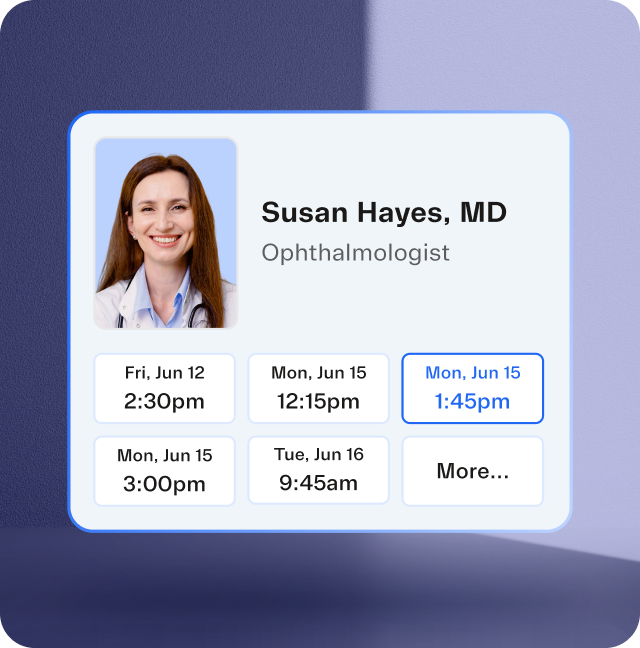
30-60% of bookings move online within 90 days, freeing your team to focus on the calls that actually need a human.
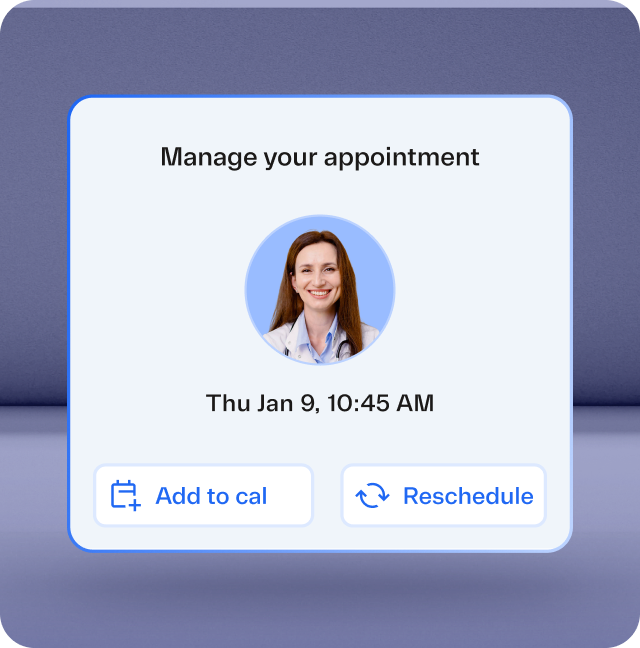
When patients can reschedule themselves at 9pm Sunday, they reschedule instead of no-showing.
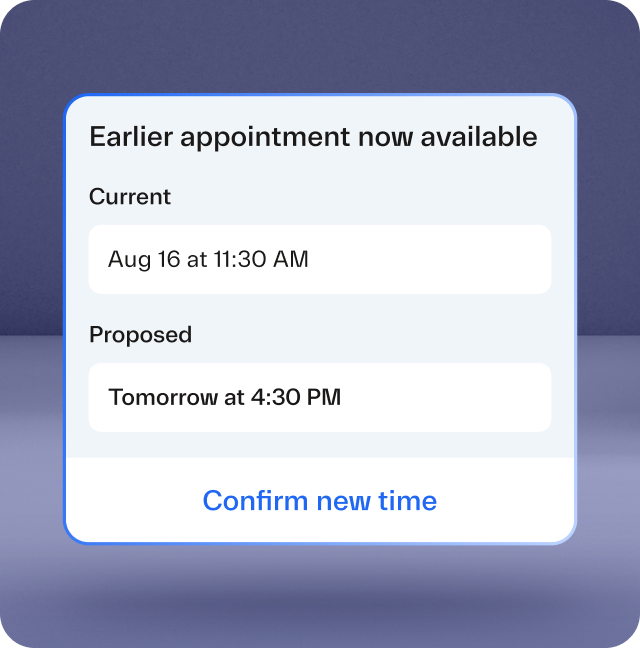
When a cancellation opens a slot, NextPatient automatically texts waitlist patients in priority order; the slot fills in minutes, without a single phone call.
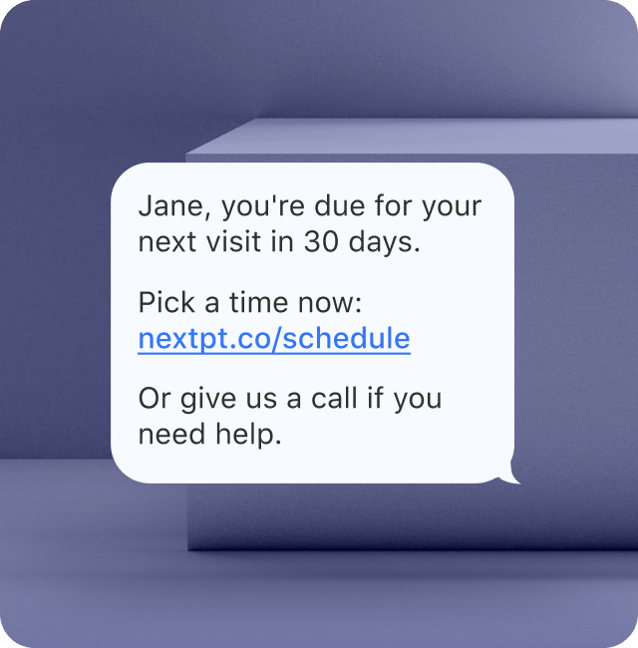
Annual visits, post-op follow-ups, treatment cadences (e.g., quarterly skin checks) are all queued and texted on schedule.
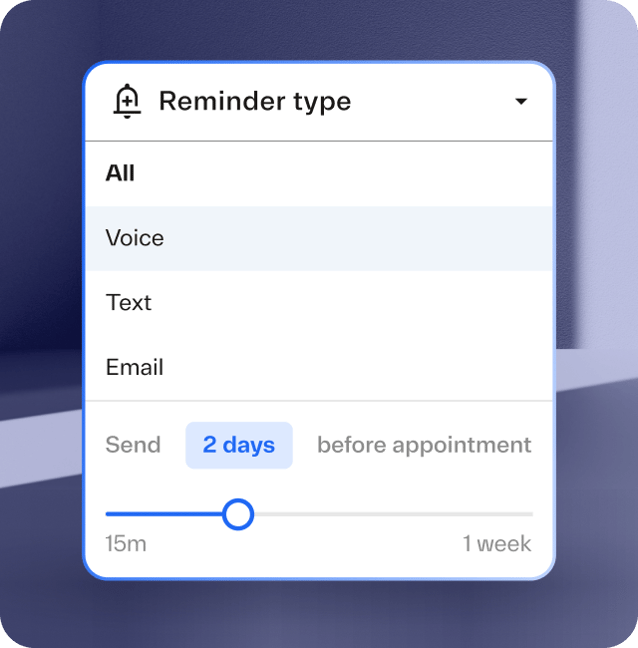
3-day, 1-day, and same-day reminders with confirm-or-reschedule taps; no more day-of "wait, I thought my appointment was Thursday" calls.
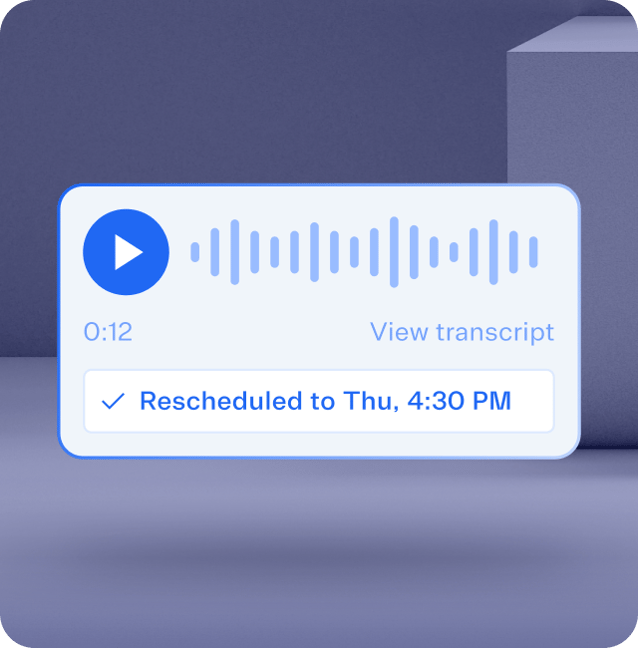
Routine scheduling calls and texts are answered and booked without anyone picking up the phone, so your team spends its time on the calls that need human judgment.
When it comes to choosing a solution, it's all about the results. We've never seen anyone do it quite as well as NextPatient.
95%
of bookings online
33+
front desk hours saved weekly
1%
no-show rate
See a 40-second booking flow as a new patient.
Patient self-scheduling software lets patients book, confirm, reschedule, and cancel medical appointments online — without calling the office. The strongest implementations integrate directly with the practice's EHR, respect the practice's existing scheduling rules (provider templates, appointment types, visit lengths), and remove the front desk workload around scheduling. NextPatient is patient self-scheduling software built specifically for specialty medical practices.
No. Patients book, confirm, reschedule, cancel, complete digital intake, and pay deposits through secure links sent by text or email — all from their mobile browser. There is no app to download, no patient portal to log into, no username or password to remember. This is one of the largest sources of patient adoption lift compared to portal-based systems, which typically see 5-15% patient adoption over 12 months.
NextPatient has bidirectional integrations with leading specialty EHRs: Nextech, ModMed, athenahealth, AdvancedMD, NextGen (Enterprise), DrChrono, Veradigm (formerly Allscripts), and CareCloud. All integrations are real-time and bidirectional — appointments, patient data, and waitlist activity write back to the EHR live, not on a nightly batch.
A patient portal is a separate logged-in environment (typically tied to the EHR vendor) where patients can view records, message providers, and sometimes book appointments. Patient portal adoption is famously low — most patients don't log in. NextPatient is not a portal. Patients book through a link, in their browser, without an account. The result is patient adoption rates several times higher than portal-based scheduling in the same practice.
Yes. NextPatient supports patient-initiated rescheduling and cancellation as a default capability. When a patient cancels through the link within the practice's cancellation window, the slot opens automatically to the waitlist. Online rescheduling and cancellation is one of the largest sources of front desk workload reduction that practices see after implementation.
Yes. NextPatient's voice AI answers your practice phone, and SMS-based chat AI handles scheduling over text message. Both book, confirm, reschedule, and cancel appointments directly in your EHR in real time, using the same provider templates, appointment type rules, and eligibility logic as online self-scheduling. When a patient needs a person, the conversation hands off to your staff with the details already captured.
No. Voice AI takes routine calls off the front desk’s plate. Booking, rescheduling, confirming, and "what time is my appointment?" calls are handled automatically, so your team can focus on the patients in front of them and the calls that need human judgment, like clinical questions, complex scheduling, and billing.
Six ways: (1) 30-60% of bookings move online within 90 days, eliminating those inbound calls; (2) patient-initiated online rescheduling eliminates rebooking calls; (3) automated waitlists fill cancelled slots without manual call-down; (4) automated recalls keep patients on the right cadence without front desk follow-up; (5) digital intake completed pre-visit eliminates clipboard handoffs at check-in; (6) voice and chat AI answer and book routine scheduling calls and website chats around the clock.
Yes. NextPatient operates under a Business Associate Agreement (BAA) with covered entities, encrypts data in transit and at rest, and maintains the audit logging, access controls, and security practices required for healthcare-grade software. We are not a generic appointment-booking tool (e.g., Calendly) retrofitted for healthcare — NextPatient was built for patient data from the start. The same protections apply to voice and chat AI conversations.
Typical implementation is 15 days from contract signature to go-live for a single-EHR specialty practice. Multi-location and multi-EHR practices typically run 30-45 days. This is meaningfully faster than enterprise patient access platforms (Kyruus, Epic-native modules), which routinely run 6-12 months for comparable scope.
NextPatient is priced per provider, per month on three plan tiers: Core, Advanced, and Pro. Average annual contract value is approximately $17.5K across our customer base. Pricing is custom-quoted based on plan, provider count, and add-ons. Talk to a specialty practice advisor for a tailored quote.
Strongest specialty depth is in dermatology, ophthalmology, and plastic surgery — our headline strongholds. We also support allergy/ENT, orthopedics, urology, OB/GYN, gastroenterology, pain management, podiatry, and primary care. We do not currently focus on urgent care (different scheduling pattern) or health systems (different buyer environment).
20 minutes is all it takes to see whether NextPatient fits your practice. Our team specializes in specialty practices — no generic SaaS demo, no checking boxes you don't care about.